
Table of Contents:
Heavy-Duty Construction for Reliable Product Protection
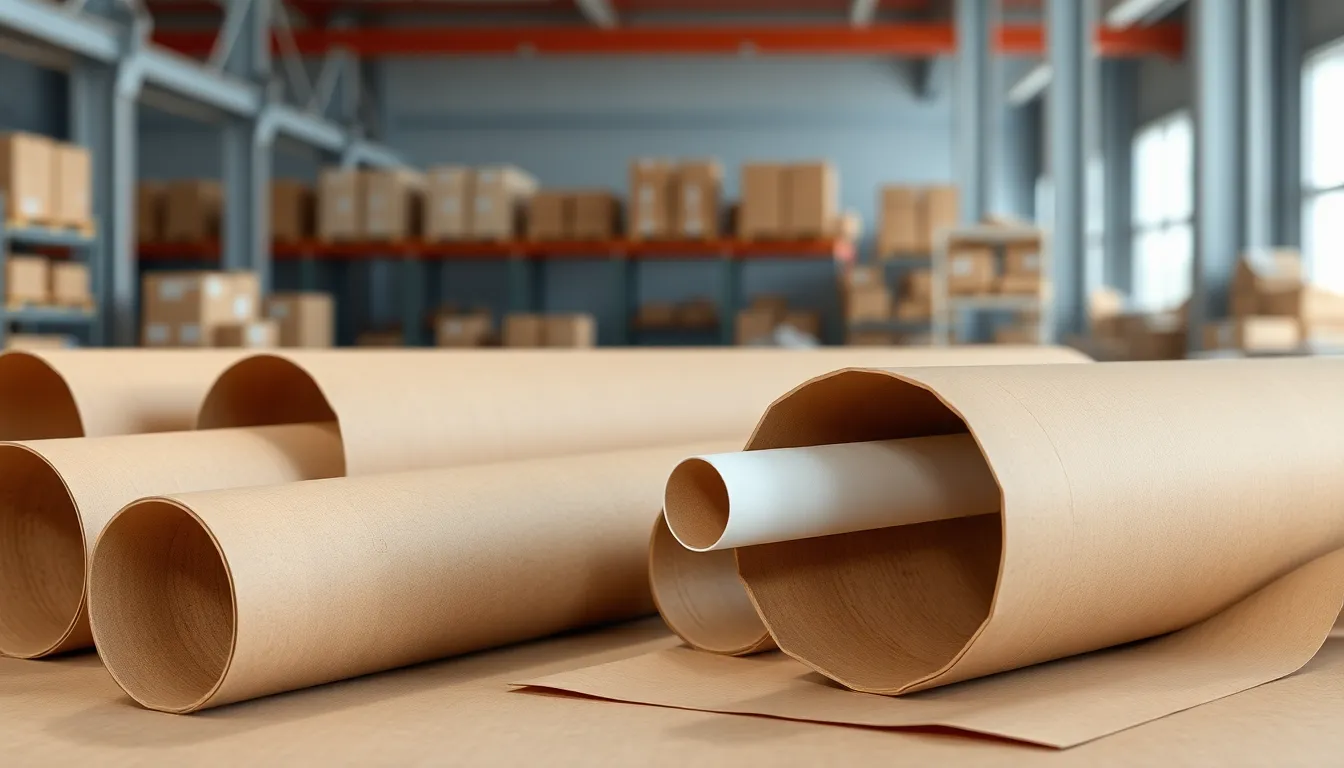
Heavy-duty packing tubes protect long products by resisting crushing, bending, twisting, and impact. Their rigid paperboard walls form a stable shell around posters, plans, prints, and rolled materials. Unlike a thin carton, a strong tube spreads pressure around its full curve, so one hard contact is less likely to crease the contents.
Strength depends on more than wall thickness. A well-built tube uses tightly wound paper layers, firm edges, and a shape that resists collapse under uneven loads. That stability matters because long parcels can act like levers: a small force at one end may create a sharp bend in the product.
For demanding shipments, choose a tube with enough internal clearance for the rolled item and its protective wrap. Too little space creates pressure points; too much lets the contents slide and may cause dents at the ends. The practical fit keeps the item centered without forcing it into the tube.
- Use a firm core: Roll paper and film around a smooth inner support to prevent flat spots.
- Protect the ends: Add secure end closures so the contents cannot push outward during handling.
- Limit movement: Fill large gaps with light, clean cushioning rather than dense material that adds stress.
- Check the shell: Reject tubes with crushed rims, splits, soft spots, or moisture damage.
Moisture can reduce tube stiffness. Place the tube inside a suitable outer mailer when the route includes rain, damp storage, or condensation. For valuable prints or technical documents, seal the inner wrap separately; the tube provides structural protection, not the only moisture barrier.
Match wall strength and closure system to the item’s value, length, weight, and exposure risk. A strong tube cannot prevent every loss, but it significantly improves the package’s tolerance for rough handling.
Choosing the Right Tube Size for Posters, Plans, and Documents
Choose the tube by measuring the item first, not by guessing from its label. Record the longest finished dimension, the rolled diameter, and the space needed for a protective sleeve. For a rolled poster or plan, the tube length should exceed the item by about 1–2 inches, while the inside diameter should allow a loose, even fit.
Length matters most for flat documents. An 18-inch print needs a tube longer than 18 inches after allowing room for end protection. A 24-inch plan may need a 25-inch or longer interior. Larger work commonly uses 37-inch tubes for extended drawings and 48-inch tubes for long posters or technical sheets. Always compare the usable interior size with the product size; outside measurements can mislead.
Diameter depends on the material and desired roll. A tight roll saves space but can leave permanent curl marks or stress delicate ink. A wider tube creates a gentler curve and works better for art prints, coated paper, maps, and documents that should lie flat soon after opening. As a starting point, keep the roll diameter at least 25–40 mm larger than the tightest safe roll for sensitive paper.
- Posters: Measure the short side after rolling and add clearance for a sleeve or tissue layer.
- Plans and blueprints: Select extra length so folded edges or title blocks do not touch the ends.
- Photographic prints: Use a larger diameter to reduce curl and avoid contact with rough inner surfaces.
- Heavy paper: Allow more room because thick stock resists tight rolling and can spring outward.
- Mixed orders: Pack items with similar dimensions together, rather than forcing several sizes into one tube.
Do not rely on empty space as cushioning. A roll that shifts from end to end can suffer impact damage even when the tube remains intact. Use light spacers at both ends, keeping them clear of the document edges. Before sealing, gently tilt the package and listen for movement; if the contents slide, adjust the fit.
For repeated shipments, create a size chart with the item code, finished roll diameter, required tube length, and approved insert. This removes guesswork at the packing bench. The best tube is the smallest size that leaves safe clearance without squeezing the product.
Heavy-Duty Packing Tube Benefits and Selection Criteria
| Feature | Benefit | Best Suited For |
|---|---|---|
| Rigid paperboard walls | Resist crushing, bending, twisting, and impact during handling. | Posters, plans, blueprints, prints, and rolled documents |
| Round construction | Distributes pressure around the curved surface and reduces crease risk. | Flexible materials shipped as a single roll |
| Proper internal clearance | Keeps products centered without creating pressure points or excessive movement. | Rolled artwork, maps, technical sheets, and sensitive paper |
| Snap-seal ends or protective plugs | Prevent contents from shifting or escaping during transport. | Routine shipments, storage, and long-distance delivery |
| Adjustable design | Accommodates different product lengths while reducing unnecessary empty space. | Variable-size documents, repair parts, and subscription shipments |
| Moisture-resistant outer protection | Helps preserve tube stiffness and protects contents from rain or damp storage. | Outdoor delivery routes and moisture-sensitive documents |
| Bulk packaging options | Support consistent packing, simplify inventory management, and reduce emergency purchases. | Businesses with regular shipping volume |
Round or Square Tubes: Selecting the Best Shape for Shipping
Round tubes are usually better for rolled posters, maps, drawings, and flexible prints. Their curved wall supports the roll evenly and resists dents from several directions. They also roll easily during handling, which can help the package pass through narrow spaces without catching on corners.
Square tubes suit flat, rigid, or neatly stacked materials. Their straight sides create a stable footprint, so packages are less likely to roll off a shelf, pallet, or packing table. They can also fit more closely together in cartons and storage rows.
- Choose a round shape for flexible items that are shipped as a single roll.
- Choose a square shape for rigid sheets, grouped documents, or parcels that must stay still during storage.
- Use round tubes when smooth outer surfaces and low snag risk matter.
- Use square tubes when stacking, labeling, or pallet organization is more important than easy rolling.
The shape changes how pressure reaches the contents. A round tube spreads a side impact around its curved wall. A square tube directs force through its corners and flat panels, which can help when the parcel is placed between other boxes. Sharp corners, however, may receive more wear on conveyor belts or rough floors.
Storage conditions may settle the decision. Round parcels need chocks, dividers, or a dedicated rack to stop them from rolling. Square parcels are easier to stack, but heavy loads above them may press on the flat panels. Keep stacking height within the tube manufacturer’s guidance and avoid concentrated weight on one edge.
For mixed operations, select the shape that matches the full handling path, not only the product. A round tube may protect a print perfectly but create problems in a narrow picking bin; a square tube may store neatly but require more care around corners.
Secure Closures with Snap-Seal Ends and Protective Plugs
The closure is the tube’s first defense against accidental opening. A strong body offers little protection if an end cap slips out, tears the rim, or leaves the contents exposed. Match the closure to the tube design and inspect both ends before the parcel enters the shipping stream.
Snap-seal ends are useful when speed matters. Their locking action can reduce packing time and eliminate separate fastening parts. Press the seal fully into place around the entire rim; a partial snap may look closed while leaving a weak section.
Plastic end plugs provide a firm fit and are easy to replace when a tube must be opened and closed during internal handling. They work well for routine storage, document transfers, and shipments needing a visible end closure. Select the correct plug diameter: an undersized cap can loosen, while an oversized one may damage the tube edge.
Metal end plugs can offer greater resistance to impact and repeated handling. They suit heavy contents, long-distance transport, or tubes that will be stacked and moved often. Their added rigidity may protect the rim, but the metal edge should sit flush and never touch the product.
- Inspect the rim for splits, dents, and crushed fibers before fitting the closure.
- Push or snap the cap into its final position without striking it with a hard tool.
- Apply shipping tape across the closure when carrier handling is rough or the contents are valuable.
- Use a tamper-evident seal when an opened parcel would create a security concern.
- Check the finished package by lifting it from the middle and gently turning it end to end.
Tape can reinforce a sound closure, but it cannot reliably hold an incompatible one. For moisture-sensitive contents, close the inner protective wrap first and treat the tube end as a mechanical barrier, not a waterproof seal.
Before shipment, confirm that the cap is fully seated, the rim is not deformed, and no part of the closure presses against the product. This prevents a common failure: the tube arrives strong but empty at one end.
Adjustable Tubes for Flexible Packaging Needs
Adjustable packing tubes are useful when shipment lengths vary. A telescoping design can be shortened or extended to match the item, simplifying stock control and reducing awkward empty space.
The benefit is controlled adjustment, not unlimited flexibility. Set the tube so the contents remain supported from end to end, then lock the sections according to the manufacturer’s method. A loose overlap can slide during transport, while too little overlap may weaken the joint.
- Measure before adjustment: Record the item length and the required clearance for inner wrapping.
- Keep the overlap generous: The joined sections need enough contact area to resist pulling and bending forces.
- Secure the seam: Use the recommended tape, clips, or locking feature across the adjustable joint.
- Do not force the fit: A compressed product may develop pressure marks or edge damage.
- Mark the final length: A simple line helps packing staff check that the tube has not shifted.
These tubes work well for subscription shipments, repair parts, art orders, and mixed-format documents. One packaging system can cover several lengths instead of requiring a new carton size for every job. That saves shelf space, though the adjustable mechanism should be tested before high-volume use.
For heavy or valuable items, inspect the overlap after packing. Hold the tube near the joint and apply gentle opposing pressure. Clicking, separation, or a visible gap signals that the connection needs correction. Keep labels away from the seam, since they can hide movement or complicate inspection.
Adjustable tubes are less suitable when automated equipment requires a fixed outer length or when the joint becomes the main load-bearing point. In those cases, a single-piece tube may perform more consistently.
Bulk Packs for Efficient Business Shipping
Bulk packs simplify business shipping when the same tube format is used every day. They reduce repeat purchasing, keep packing stations supplied, and give staff a consistent package to handle.
Plan stock around actual shipment volume rather than choosing the largest pack available. A simple forecast can prevent shortages and overstock:
- Estimate the average number of tubes used each week.
- Add a buffer for seasonal peaks, damaged stock, and urgent orders.
- Compare that figure with the pack quantity before placing a purchase order.
- Set a reorder point based on supplier lead time and current usage.
Pack quantity also affects handling. A bundle of 10 large tubes may be easier to move safely than a loose stack, while a 50-piece case of smaller tubes may need a cart or two-person lift. Store cases on level surfaces, keep them dry, and avoid leaning long bundles against walls.
Businesses with several tube sizes should label each storage position with the internal size, length, closure type, and pack count. This reduces picking errors and prevents staff from opening a new case when a partly used one is available.
Track consumption by product line or shipping station. The data may show that one size is overordered, another is used only during a short campaign, and a third justifies a standing supply agreement. Bulk buying works best when it follows measured demand.
Review total cost rather than case price alone. Include storage space, internal movement, damaged units, replenishment labor, and emergency purchases. A slightly smaller pack may be smarter if it turns faster and frees warehouse room.
How Strong Tubes Reduce Crushing, Bending, and Handling Damage
Strong packing tubes manage force before it reaches the product. During sorting and delivery, parcels may be pressed by neighboring boxes, caught under straps, or dropped onto an edge. A rigid tube resists these loads and keeps the contents away from the main impact zone.
Crushing usually starts at a weak point: a thin wall, damaged rim, or long unsupported section. Heavy-duty paperboard spreads pressure along its length instead of allowing one spot to buckle. This is especially useful for oversized parcels, where a small dent can become a full crease.
Bending creates a different risk. When a long package is lifted from one end, its weight produces a bending moment. Tube stiffness helps keep the centerline straight, reducing the chance that a rolled print or document develops a hard fold. Protection improves when the item is supported close to both ends rather than floating inside a long cavity.
Handling damage is often cumulative. Repeated drops, vibration, and sideways pressure may weaken a package without causing immediate visible failure. A strong tube provides a tougher shell and lowers the movement transferred to the contents.
- Against crushing: A firm wall spreads top and side pressure over a wider area.
- Against bending: Longitudinal stiffness helps the parcel keep its shape when lifted or supported unevenly.
- Against edge impact: Reinforced rims reduce the chance that a corner collapses inward.
- Against repeated handling: A durable shell keeps its protective form through more stages of transport.
A strong tube is not an excuse for careless loading. Avoid placing a long parcel beneath dense, heavy freight. Use dividers when several tubes share a container, and keep barcode labels on a smooth, readable section.
For valuable products, run a small handling trial before scaling up. Pack representative items, expose them to normal warehouse movement, and inspect the tube and contents afterward. Look for flattened sections, shifted rolls, edge marks, or new creases.
Custom Tubes for Specialized Products and Brand Needs
Custom tubes make sense when standard packaging creates waste, slows packing, or fails to suit the product. A tailored design can combine a specific length, internal diameter, wall build, end style, and outer finish. This gives manufacturers control over the shipping system instead of forcing an unusual item into an ordinary container.
Begin with the product’s handling needs. A supplier may require finished dimensions, weight, center of gravity, surface sensitivity, storage time, and expected shipping route. For technical parts, also note sharp edges, protruding fittings, or oils that could affect the inner liner.
- Product-specific dimensions: Reduce unused space around unusual lengths or shapes.
- Special inner protection: Add liners, sleeves, or inserts for abrasion-sensitive surfaces.
- Distinct outer finishes: Use printed or colored surfaces for brand recognition and faster identification.
- Storage tubes: Create durable holders for items that must remain organized between uses.
- Custom closures: Match access needs, security expectations, and repeated opening cycles.
Branding can support operations as well as marketing. A printed tube can show a handling symbol, product family, orientation mark, or return instruction. Color coding may help workers separate sizes or shipping classes. Keep essential labels readable after transport tape, carrier labels, and barcodes are added.
Prototype testing should come before a large production run. Inspect fit, loading time, closure action, label area, and unpacking. Then send samples through the intended carrier route or a controlled handling trial. Measure damaged rims, scuffed surfaces, loose inserts, and excessive packing labor.
Document the approved dimensions, material specification, artwork version, closure type, and inspection criteria. If the product changes, update the drawing rather than relying on a verbal instruction. This avoids the “almost the same tube” problem, which can cause fit and supply issues.
A tailored tube is worthwhile when it removes a recurring cost or protects a product that standard packaging cannot handle reliably. The strongest design is not necessarily the thickest; it is the one built around the product, workflow, and journey.
Fast Availability for Time-Sensitive Shipping Orders
When deadlines are tight, packaging availability becomes part of the delivery plan. Ready-to-ship heavy-duty mailing tubes can help teams avoid delays caused by custom production or last-minute sourcing. This is valuable for poster orders, engineering documents, display graphics, and other long items that cannot be folded into standard parcels.
Some stocked tube programs offer same-day dispatch for orders placed by a stated cutoff, such as 4:00 p.m. Eastern Time. Treat that promise as a dispatch window, not a guaranteed delivery date. Transit time, weekends, carrier capacity, weather, and destination rules still affect arrival.
Build a simple deadline check before ordering:
- Confirm the local cutoff: Note the time zone and whether the deadline applies to business days only.
- Check stock status: Separate immediately available sizes from items with a future availability date.
- Allow packing time: Include receiving, inspection, labeling, and carrier handoff in the schedule.
- Verify the destination: Remote areas and international routes may need extra transit time.
- Keep a fallback size: Pre-approve another suitable tube if the preferred format sells out.
A small emergency supply can protect critical shipments from a stock interruption. Store it away from normal daily use and review the quantity after each peak period. The reserve only needs to bridge the gap until regular stock arrives.
For large operations, connect tube inventory to the shipping calendar. A trade show, product launch, school term, or seasonal campaign can create a sudden demand spike. Ordering a few days before that event may be too late, even when the supplier normally dispatches quickly. Fast availability helps most when the order is planned before the pressure starts.
Before relying on any dispatch service, confirm the current cutoff, stock count, freight method, and handling conditions directly with the supplier. Record the confirmation with the purchase order.
Example: Packing a 48-Inch Poster for Safe Delivery
Pack a 48-inch poster with a controlled roll, a clean inner barrier, and enough room for safe removal. The aim is to prevent pressure marks, telescoping, and edge damage without making the parcel unnecessarily large.
Check that the poster is fully dry and free of dust. Place it image-side inward only when the print manufacturer allows that method; some finishes can mark or stick under pressure. For delicate or coated artwork, use acid-free tissue or a smooth archival sleeve as the first protective layer.
- Prepare the roll: Place the poster on a clean, flat surface and align its edges before rolling. Keep the roll straight rather than letting one side lead.
- Add an inner support: Use a smooth, rigid core slightly longer than the poster width. This keeps the roll round and gives the sheet a stable center.
- Secure the outer layer: Wrap the poster with a suitable sleeve or unprinted paper. Do not apply adhesive directly to the artwork.
- Select the tube: For a 48-inch poster, use a tube with a usable interior length above 48 inches. A common 48-inch tube may be too short once end clearance is considered.
- Center the roll: Insert it gently and keep equal space at both ends. Avoid pushing the poster against a cap or plug.
- Control end movement: Add clean, lightweight spacers that hold the roll in place without pressing on its edges.
- Close and identify: Fit both ends securely, then place the address label on a straight, readable area of the outer surface.
Do not tape the poster into a tight cylinder. The sheet should remain relaxed enough to unroll without a sharp memory line. If the roll resists insertion, increase the tube diameter or reduce the wrapping layer rather than forcing it.
Before dispatch, inspect the package from end to end. The tube should remain straight, closures should sit flush, and no internal movement should be obvious when the parcel is gently turned. Mark the package with a clear “Do Not Bend” instruction where the carrier’s labeling rules permit it.
For high-value artwork, photograph the poster before packing and record the tube size, inner protection, and closure method. This packing record improves consistency for repeat orders.
Fazit: Match Tube Strength, Size, and Closure to the Product
The best heavy-duty packing tube is a balanced system, not simply the thickest option available. Strength should match the product’s weight and handling risk, size should support the item without wasting space, and the closure should remain secure through loading, transport, storage, and opening.
Before approving a tube, assess the complete package. Confirm fit, closure performance, label area, storage method, and shipping route. A tube that works at the packing bench may still create problems on a narrow shelf, conveyor, or mixed freight load.
- Low-risk documents: Use a practical wall build with a closure that suits routine handling.
- Fragile or high-value items: Add suitable inner protection and choose a tube with greater structural margin.
- Variable product ranges: Consider adjustable formats or a small set of standard sizes.
- Repeated business use: Select a design that supports fast packing and consistent quality checks.
- Special shapes or branding: Request a custom specification after testing a representative sample.
Keep a short packaging specification for every product family. Record the approved tube, inner protection, closure, maximum packed weight, and inspection points. This turns personal packing habits into a repeatable process and simplifies staff training.
Review the choice after real shipments, not only after visual inspection. Track crushed ends, open closures, moisture exposure, customer complaints, and returns. If failures appear, change one variable at a time so the cause is clear. The solution may be a stronger wall, a better fit, a different closure, or a change in loading.
Reliable protection comes from matching the tube to the product and the journey. Test that match under realistic conditions and document the result so heavy-duty packaging becomes a dependable part of the shipping process.
Frequently Asked Questions About Heavy-Duty Packing Tubes
What are heavy-duty packing tubes used for?
Heavy-duty packing tubes are used to ship and protect long or rolled items such as posters, plans, blueprints, photographs, prints, maps, and technical documents. Their rigid construction helps reduce crushing, bending, twisting, and impact damage during handling and transport.
How do I choose the right packing tube size?
Measure the item’s finished length and rolled diameter, then allow additional space for protective wrapping and end clearance. The tube should be slightly longer than the product and wide enough to hold it without pressure points or excessive movement.
Are round or square packing tubes better?
Round tubes are generally best for rolled posters, maps, drawings, and flexible prints because they distribute pressure evenly around the contents. Square tubes are suitable for rigid sheets, grouped documents, and shipments that need stable stacking and storage.
How can I secure the ends of a heavy-duty packing tube?
Use compatible snap-seal ends, plastic plugs, or metal end closures. Ensure that each closure is fully seated and fits the tube diameter correctly. Shipping tape can provide additional reinforcement, but it should not replace a properly fitted closure.
Can heavy-duty packing tubes be customized?
Yes. Custom packing tubes can be produced with specialized lengths, diameters, wall constructions, liners, closures, colors, printed designs, and protective features. Custom specifications are useful for unusual products, recurring shipping requirements, storage applications, and branded packaging.